Noillirk Tips: How to Choose the Most Common Answer
Learn a practical way to compare familiar answers, avoid overthinking, and make better choices in Noillirk's fifteen-second rounds.
You read a prompt, think of three perfectly reasonable answers, and hesitate. Which one belongs at the top?
That is the central decision in Noillirk. A response can fit the question and still earn fewer points than another familiar answer. Improving means getting better at comparing those candidates before you submit.
This guide covers Noillirk on noillirk.im, the independently developed game on this website. Each game has seven English prompts and fifteen seconds of answering time per round. These tips are practical approaches to try, not a guarantee of a particular answer rank.
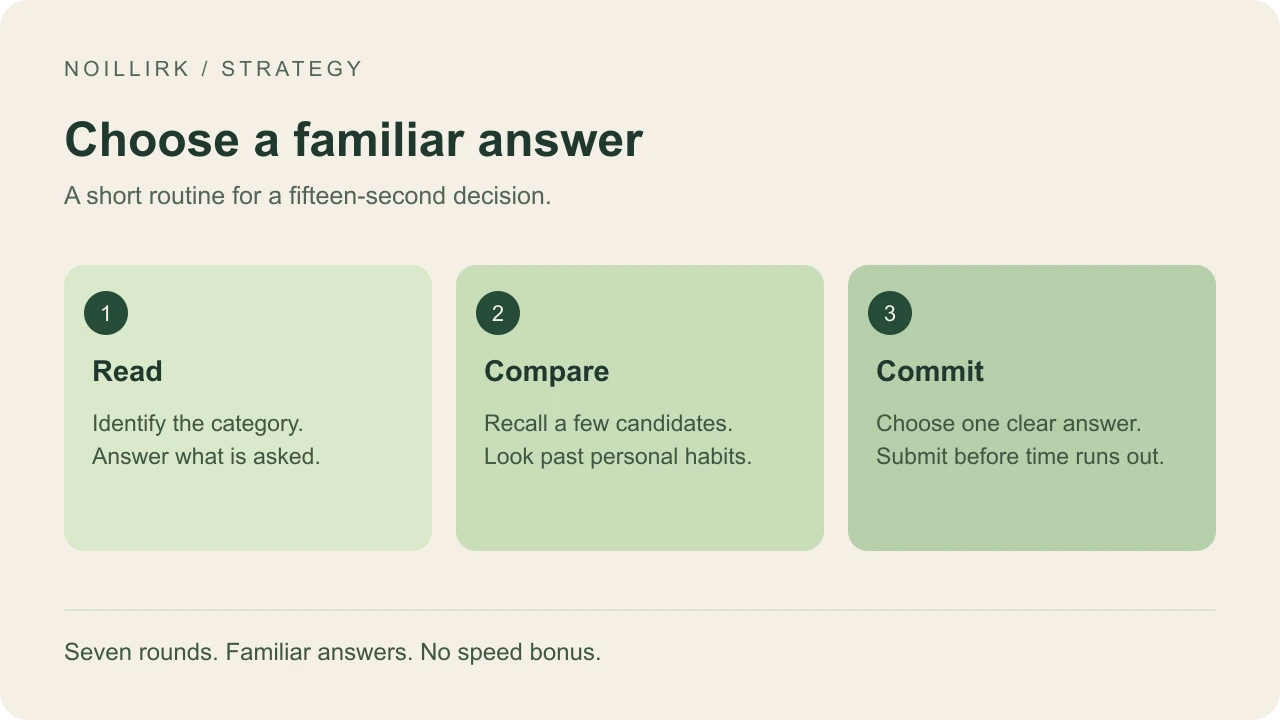
Read the category before searching your memory
Start with what the question actually asks. Is it asking for an object, a place, an activity, or a particular kind of food? A familiar response still needs to belong to the requested category.
Imagine the prompt asks for something you use to carry groceries. A shopping bag and a basket are plausible candidates. A supermarket is related to groceries, but it is a place rather than something you carry them in.
This example is invented to explain the decision. It is not an actual answer board, and it assigns no scores.
Compare a few familiar candidates
Instead of producing a long list, bring two or three plausible answers to mind. Then ask which feels most broadly associated with the prompt.
In the grocery example, your own routine might make a backpack your immediate thought. That is useful information about you. It does not settle whether a bag or basket belongs higher in the game's list.
The goal is to notice the difference between a personal habit and a familiar association. You still have to choose; the strategy cannot reveal the hidden ranking.
Prefer a clear answer at the requested level of detail
A longer answer does not earn extra points. If the question calls for an ordinary object, extra adjectives or a brand name may add little and make matching less straightforward.
But do not automatically shorten every response. If a prompt requests a particular species, country, or named item, a broad category may fail to answer it. Let the wording determine how specific you should be.
On this site, spelling variants, plurals, and synonyms match only when they are explicitly listed for that question. A shorter word is not automatically accepted, and two related expressions are not automatically interchangeable. Read why an answer may be unlisted for the matching rules.
Use the available time without chasing a speed bonus
Noillirk does not award bonus points for answering quickly. If you already have a good candidate, use a moment to check the category and spelling before submitting.
Avoid turning that pause into an endless search. The first accepted answer settles the round, and an action at exactly fifteen seconds is too late. You need to make a choice within the available window.
Submitting pauses the answering clock during processing. If the answer is unlisted, the remaining time resumes when the response is ready. That lets you try another response without the processing wait consuming your answering time.
Learn from the reveal between rounds
After a round, compare your choice with the leading answers shown in the feedback. Ask one useful question: did I misunderstand the category, choose an unusually specific example, or simply rank two familiar candidates differently?
You can read before starting the next round. Feedback does not automatically begin the next timer, so there is no need to rush your review.
Treat each reveal as information about that question. It does not prove that the same answer will rank highly under a different prompt.
Practice one habit at a time
In unlimited practice, choose a single focus for a game: reading the category carefully, comparing a few candidates, or avoiding unnecessary detail. Review the result before changing your approach.
Practice uses a separate question pool from Daily, so its value is developing a decision routine rather than previewing today's questions. See Daily vs unlimited practice for how the modes work.
If your instinct is still to find something obscure, the Krillion vs Noillirk comparison explains why that approach points in a different scoring direction. You can also check seven common mistakes before your next game.
Try a practice game, or put your choices to the test in today's Daily.
Rules checked against this site's How to play and Scoring guides on October 25, 2026. Examples and artwork are explanatory, not live question answers.