Krillion vs Noillirk: Rare Answers or Common Ones?
Krillion rewards unusual valid answers. Noillirk rewards familiar ones. Explore the difference in strategy, scoring, and the Noillirk game on this site.
Imagine a game asking you to name a fruit. Do you type the first familiar answer that comes to mind, or search your memory for something most people would overlook?
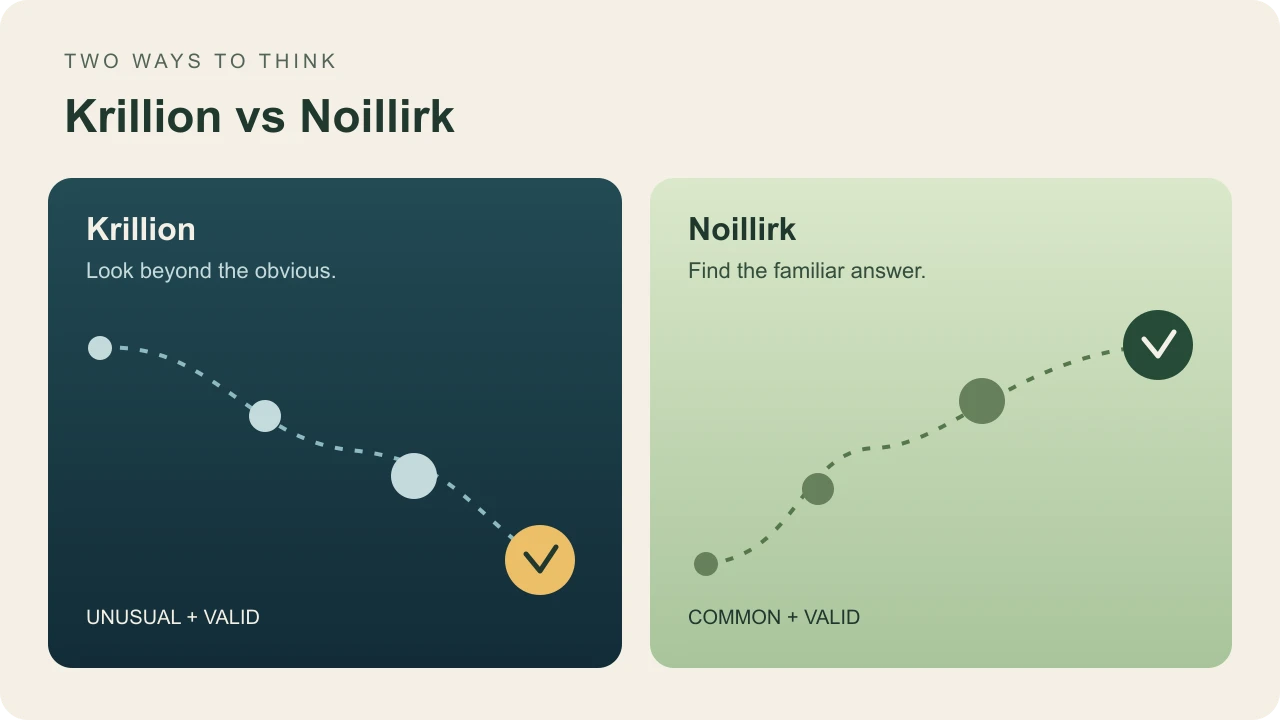
That choice captures the main difference between Krillion and Noillirk. Krillion rewards unusual valid answers. Noillirk rewards common answers. Both use open prompts, but the direction of the reward changes how you approach them.
First, know which version you are playing
The original Krillion is hosted at krillion.io. Its creator identifies themselves as kp in the Krillion FAQ.
Daily hosts its own Krillion adaptation and a game called Noillirk. Its About page describes Noillirk as its own reversal of the rare-answer idea.
Noillirk on noillirk.im, this website, is an independently developed common-answer game. It has its own questions, scoring implementation, and original scenery. It is separate from both the original Krillion and Daily's games. The Noillirk rules described below refer to this website unless another version is named.
Krillion: keep looking beyond the obvious
In Krillion, an everyday answer may fit the prompt without being your strongest scoring opportunity. The challenge is to recall something less familiar that still belongs in the category.
That can reward detailed knowledge: a particular species, a regional food, or an example you remember from a hobby. A useful way to approach the game is to identify the obvious candidates, then ask what else you know.
Rarity is not permission to invent an answer. It still has to fit the prompt and be accepted by the game. Nor is every score a simple inverse of word frequency. The original creator explains that scoring can involve familiarity data, model assistance, and manual review, with the highest tier also considering how satisfying an answer is to find. See the original scoring explanation.
Noillirk: choose the familiar answer carefully
On noillirk.im, the challenge is to choose an answer near the top of the question's answer list. You play seven English prompts, with fifteen seconds of answering time per round. A first-ranked answer earns 100 points, and seven such answers produce a perfect 700.
The difficulty often comes from choosing between several reasonable everyday answers. Your favorite example, or the one most familiar in your profession, may differ from the answer that ranks highest in the game.
Consider the imaginary fruit prompt again. An apple and a less familiar fruit could both fit. The rare-answer approach encourages you to explore the less obvious option. The common-answer approach makes the apple worth considering seriously.
This is an illustration of the strategy, not a real answer board or a promise about either game's scores. Actual results depend on the prompt and its accepted answers.
The difference at a glance
| Question | Krillion's core approach | Noillirk on this website |
|---|---|---|
| What am I aiming for? | An unusual answer that fits | A familiar answer near the top of the list |
| What should I ask myself? | What else do I know beyond the obvious? | Which familiar answer is the strongest candidate? |
| Where does the challenge lie? | Recalling a less common valid example | Choosing between plausible common examples |
| What feels rewarding? | Finding an unexpected answer | Correctly anticipating a familiar association |
These are strategic differences, rather than a claim that one game is harder. Knowing many obscure facts can help you search for rare answers, but it does not automatically help you rank ordinary ones.
How scoring works on noillirk.im
Accepted answers receive a fixed score based on their rank in the question's answer list.
| Answer rank | Points |
|---|---|
| 1 | 100 |
| 2–4 | 64 |
| 5–9 | 32 |
| 10–19 | 16 |
| 20–39 | 8 |
| 40 or lower | 4 |
| Skip or timeout | 0 |
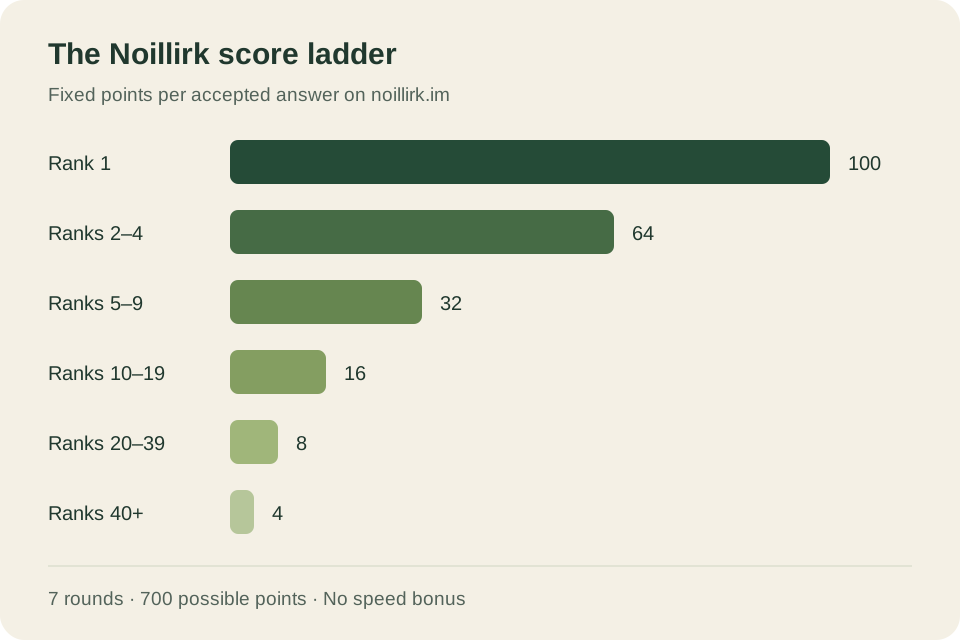
The first accepted answer settles the round. You cannot secure a small score and then keep trying to improve it on the same prompt. An unlisted answer lets you try again while answering time remains; it does not necessarily mean your response is objectively wrong.
There is no speed bonus. Submitting pauses the answering clock during processing, and an unlisted response resumes the remaining time. You can read the feedback between rounds before starting the next question. The scoring guide and how-to-play page explain the details.
Daily and practice on this website
The Daily challenge has seven fixed questions for the date and resets at 00:00 UTC. It gives you one official game per browser identity for that date.
Unlimited practice draws from a separate question pool. It uses the same scoring rules while keeping its results separate from Daily. You can play either mode without creating an account.
These details belong to noillirk.im. Other websites with the same game name can have different modes, timers, answer lists, and visual journeys.
Which style will you enjoy?
Try Krillion when you feel like searching through your knowledge for an unexpected example. Try Noillirk when you want to judge which ordinary answer is most likely to sit near the top.
Playing both can also expose an interesting habit: the answer you instinctively avoid in one style may be exactly the answer you should consider in the other.
To try the common-answer approach here, start today's Daily or play a practice game. Your next difficult decision might be choosing the most ordinary word on the page.
Keep exploring Noillirk
- Krillion alternatives: seven games to try next
- Tips for choosing a common answer
- Seven common mistakes and how to avoid them
- Daily vs unlimited practice
- Why an answer may not be accepted
Version note: checked on October 25, 2026. External product descriptions are based on the Krillion FAQ and Daily About page. This site's rules are documented in How to play, Scoring, and About. Illustrations are original explanatory artwork, not screenshots of either external game.