Krillion Alternatives: 7 Games to Try Next
Looking for a Krillion alternative? Compare seven answer and word games, from the common-answer twist of Noillirk to Pointless, Family Feud, and Scattergories.
You finished today's Krillion dive and want another round. Maybe you are tired of hunting for the most obscure valid answer, or maybe you want the same feeling in a different format.
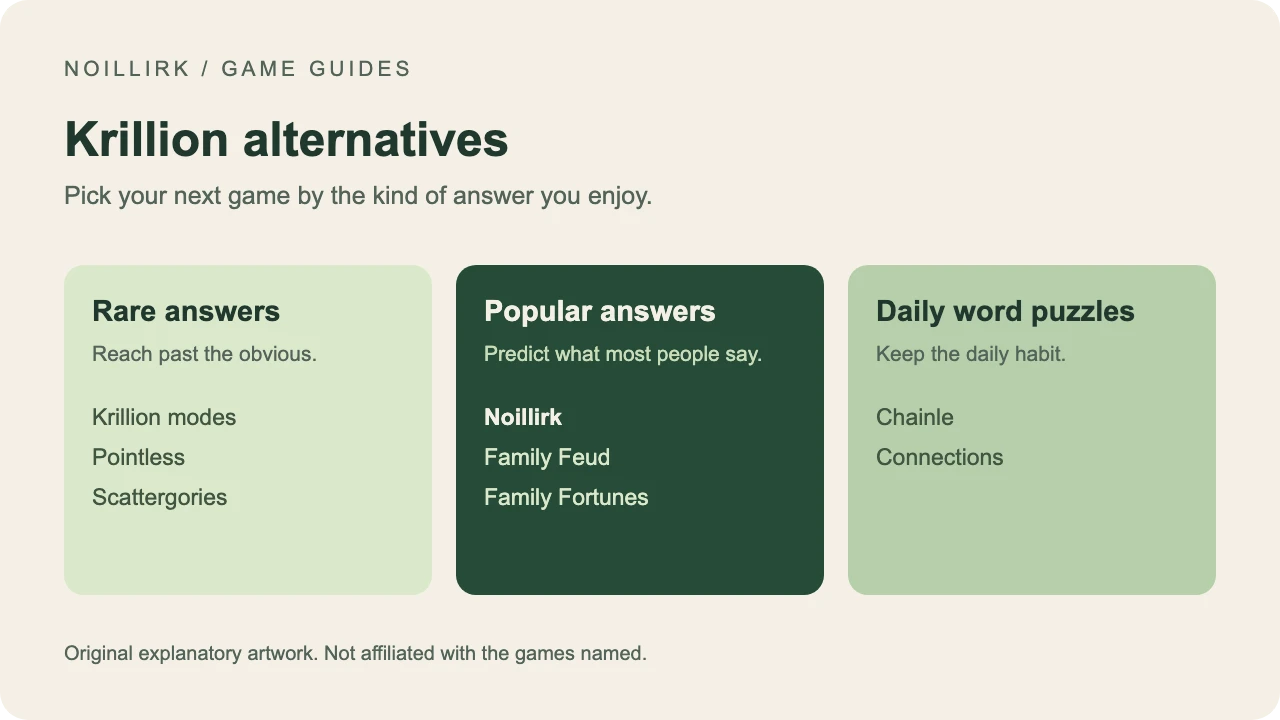
This guide groups Krillion alternatives by what you enjoy about the game: rare answers, popular answers, or open-ended word puzzles. Each entry explains how the scoring idea compares with Krillion, so you can choose by play style rather than by name.
What makes Krillion distinctive
Before comparing alternatives, it helps to name what Krillion does. The original game at krillion.io asks open prompts and rewards valid answers that are less familiar. Its FAQ explains that answer lists are assembled from sources such as dictionaries and encyclopedias, with rarity estimated through familiarity data, model assistance, and manual review.
So the core loop has three parts:
- An open category rather than a single hidden word.
- A list of accepted answers that you have to match.
- A score that depends on how familiar your answer is.
The games below keep one or more of those parts and change the rest.
Quick comparison
| Game | Format | What scores well | Closest to Krillion because |
|---|---|---|---|
| Noillirk (this site) | Seven daily or practice prompts, online | The most common answers | Same open-prompt format, reversed reward |
| Krillion's other modes | Online | Rare answers | Same game, different pacing |
| Pointless | TV quiz show and spin-offs | Correct answers few people gave | Also rewards obscure correct answers |
| Family Feud / Family Fortunes | TV game show and home versions | Answers many surveyed people gave | Also matches a ranked answer list |
| Scattergories | Party board game | Valid answers nobody else at the table wrote | Also rewards avoiding the obvious |
| Chainle | Daily online word puzzle | Finding the connecting word | Daily cadence and word knowledge |
| Connections | Daily online word puzzle | Grouping sixteen words correctly | Daily cadence and category thinking |
Formats and rules can change. Check each game's own help page for the current version.
1. Noillirk: Krillion turned upside down
If you like Krillion's open prompts but want a new strategic challenge, start here. Noillirk on noillirk.im keeps the open-category format and reverses the reward: answers near the top of the question's list score the most.
Each game has seven English prompts with fifteen seconds of answering time per round. A first-ranked answer earns 100 points, so a perfect game is 700. There is no speed bonus, and you can play without creating an account.
The interesting part is how differently your brain works. In Krillion, you push past the obvious. In Noillirk, the obvious answer is often the target, but you still have to pick the most obvious of several reasonable candidates. The Krillion vs Noillirk comparison walks through that shift in detail.
Play today's Daily for the fixed seven-question challenge, or try unlimited practice when you want another game right away.
Name note: Noillirk on this website is an independently developed game. It is separate from the original Krillion and from the Noillirk game that the Daily website describes as its own reversal of Krillion on its About page.
2. Krillion's own extra modes
Sometimes the best Krillion alternative is a different way to play Krillion itself. The Krillion FAQ lists modes beyond the daily dive, including Unlimited, an Archive, and Themed packs.
Choose this route when you love rare-answer scoring and only want more of it. The archive is useful for catching up on missed days, while themed packs can suit players with deep knowledge of a particular subject.
3. Pointless: the TV version of rare answers
The British quiz show Pointless is probably the best-known rare-answer format. Contestants give correct answers to a category, and the score reflects how many people in a pre-show survey of 100 gave the same answer. Lower is better, and a correct answer nobody gave is "pointless," the ideal result.
If Krillion's appeal for you is the thrill of a correct answer almost nobody else would think of, Pointless captures that feeling in a team and elimination format. It works well as something to watch along with, testing your own answers against the board.
4. Family Feud and Family Fortunes: the popular-answer classic
Family Feud in the United States and Family Fortunes in the United Kingdom ask contestants to guess the most popular responses to a survey question. Top answers are worth the most.
This is the closest traditional relative of the common-answer idea. Like Noillirk, it rewards predicting what most people would say rather than what you personally know. Unlike Noillirk, it is built around teams, strikes, and stealing points, so it suits a group setting more than a quick solo session.
5. Scattergories: rare answers at the table
In Scattergories, players write answers for a list of categories, each starting with the same letter, before the timer runs out. When two players give the same answer, it usually does not score. That pushes everyone toward valid answers that others are unlikely to write.
It is a good offline Krillion alternative for game night. The rarity is measured against the people at your table rather than against a large answer list, which makes every round a small exercise in predicting what your friends will think of first.
6. Chainle: a daily word-bridge puzzle
If your favorite part of Krillion is the daily ritual and the vocabulary workout, Chainle is worth a look. It is a daily word puzzle built mostly around word bridges: you find the word that connects two clues. Everyone gets the same puzzle each day.
It does not use rarity scoring, so it feels more like solving than recalling. Try it when you want a short daily word game that rewards knowing how words combine.
7. Connections: category thinking in sixteen words
The New York Times game Connections gives you sixteen words to sort into four hidden groups. You have a limited number of mistakes before the puzzle ends.
Krillion asks you to generate members of a category. Connections flips that around: you are given members and have to discover the categories. Players who enjoy Krillion's category prompts often like that reverse direction, especially the trickier groups built on wordplay.
How to choose your next game
- You love finding obscure answers: stay with Krillion's extra modes, watch Pointless, or bring Scattergories to game night.
- You want a fresh challenge with a familiar format: play Noillirk. The prompts feel similar, but your best answer is often the one you would normally skip.
- You want a group game: Family Feud style games and Scattergories both work well with friends.
- You mainly want a daily word habit: add Chainle or Connections to your routine.
Many players keep more than one in rotation. Playing a rare-answer game and a common-answer game on the same day is a surprisingly good exercise: it makes you notice which answers you instinctively reach for and which you avoid.
Getting started with Noillirk
New to the common-answer approach? These guides cover the basics:
- Tips for choosing a common answer
- Seven common mistakes and how to avoid them
- Daily vs unlimited practice
- Why an answer may not be accepted
- How scoring works and how to play
Ready to test your instincts? Start today's Daily. After a session of hunting for rare answers, choosing the most ordinary one can be harder than it sounds.
Version note: checked on October 26, 2026. Descriptions of external games are summaries of their general format and may not reflect every edition or rule variant. Krillion details are based on the Krillion FAQ. All trademarks belong to their respective owners, and this site is not affiliated with any game listed above. Illustrations are original explanatory artwork, not screenshots of any external game.